
Introduction
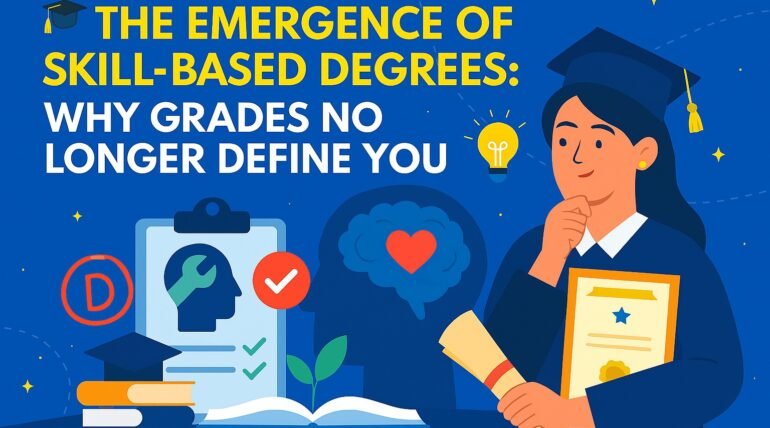
Once upon a time, marks ruled everything. But today, skill-based degrees are rewriting the story.
Success now depends not on grades but on capabilities. Employers no longer ask, “What’s your percentage?” — they ask, “What can you do?”
Across India, forward-thinking colleges are embracing a new era of education — one focused on skills, creativity, and real-world application. This shift is transforming students into job-ready professionals, innovators, and lifelong learners.
Why the Shift from Marks to Skills?
The world of work is evolving faster than ever. With automation, AI, and digital innovation reshaping industries, employers now seek adaptable thinkers — not rote learners.
What’s Changing:
- Outdated syllabi are being replaced by industry-driven courses.
- Employability is measured by real-world application, not grades.
- Students are building skill portfolios instead of just mark sheets.
As a result, colleges are emphasizing experiential learning — through internships, projects, and simulations — to produce confident, competent graduates ready for a changing job landscape.
How Do Skill-Based Degrees Work?
Skill-based programs combine academic depth with hands-on experience and industry exposure. These degrees focus on employability and practical application, helping students learn by doing.
Popular Examples Include:
- B.Voc (Bachelor of Vocation) in fields like Tourism, Data Science, or Retail Management.
- B.Sc in Design Thinking, Cybersecurity, or Applied AI.
- Integrated Dual-Degree Programs balancing academic theory with practical training.
Students learn through case studies, live projects, hackathons, and mentorship programs — creating a bridge between the classroom and the workplace.
How Colleges Are Leading This Transformation
India’s education system is evolving, thanks to collaborations between academia and industry. Modern colleges are redesigning curricula to match employer expectations and global standards.
🏛️ 1. Industry-Linked Curriculum
Courses are co-developed with industry experts to ensure every subject aligns with real job requirements.
💻 2. Hands-On Learning
Labs, simulations, and field projects allow students to apply theory to real-world problems — boosting confidence and competence.
📜 3. Certification + Degree Integration
Many universities now embed professional certifications (like Google, AWS, or NPTEL) within degree programs, enhancing employability.
🤝 4. Internships and Apprenticeships
Early exposure through internships turns education into practical training — preparing students for real workplace challenges.
Benefits of Skill-Based Education
Skill-based education offers a transformative advantage for modern learners.
🚀 1. Career Readiness
Graduates showcase portfolios and projects, not just report cards — proving their real-world abilities.
🧠 2. Industry Recognition
Employers prefer candidates who can perform tasks effectively, not just recite theories.
💡 3. Innovation and Creativity
Programs emphasize problem-solving and design thinking, cultivating entrepreneurial mindsets.
🌍 4. Global Employability
Global recruiters prioritize skills over marks. Skill-based programs give Indian graduates an international edge.
❤️ 5. Confidence and Leadership
Hands-on learning builds self-assurance, adaptability, and teamwork — qualities every leader needs.
Top Indian Colleges Offering Skill-Based Degrees
Several Indian universities are pioneering the shift toward skill-focused education:
- Symbiosis Skills and Professional University (SSPU) – Pune
- Amity University – Industry-Integrated Programs
- Bharathiar University – B.Voc Courses
- O.P. Jindal Global University – Interdisciplinary Skill Majors
- Delhi Skill and Entrepreneurship University (DSEU) – Delhi
These institutions bridge the gap between education and employment, creating graduates who are innovators, thinkers, and doers.
From Marks to Mastery: A New Mindset
In the 21st century, your skills are your new degree.
A student with practical knowledge of coding or design thinking often outperforms one with perfect grades but no experience.
Education is no longer about how much you study — it’s about how well you apply what you learn.
Skill-based education empowers students to build their own careers, explore passions, and create impact in their chosen fields.
Conclusion
The rise of skill-based degrees marks the beginning of a more inclusive, innovative, and opportunity-driven education system in India.
It proves that success doesn’t belong only to toppers — it belongs to thinkers, creators, and problem-solvers.
Whether your passion lies in technology, design, or entrepreneurship, there’s a skill-based pathway waiting for you.
✨ Explore your future with Pick Your College — and find programs that help you turn your talent into a thriving career, where your skills define your success, not your grades.