
Introduction
When preparing for NEET, one question always confuses students — “NCERT vs Reference Books: What’s Best for NEET Prep?”
With nearly 80–90% of NEET questions derived from NCERT, especially in Biology, it’s easy to assume NCERT alone is sufficient. However, NEET doesn’t just test what you remember—it also measures how well you can apply concepts, solve problems, and think analytically.
So, how do you strike the right balance between NCERT vs reference books?
In this guide, let’s explore the role of each, their subject-wise importance, recommended resources, and how you can blend both for a 600+ score in NEET.
🌿 Why NCERT Is Crucial for NEET Preparation
NCERT textbooks are the foundation of NEET preparation. They simplify complex concepts across Biology, Chemistry, and Physics, helping students build conceptual clarity from scratch.
✅ Key Advantages of NCERT:
- Explains fundamental concepts step-by-step
- Written in simple, easy-to-understand language
- Ideal for last-minute revision
- Includes well-labeled tables, diagrams, and flowcharts
- Directly aligns with 80–90% of NEET Biology questions
- Helps reinforce memory retention through concise summaries
In short: NCERT is essential — but not enough on its own.
📘 Why You Need Reference Books Too
While NCERT builds your foundation, reference books take your preparation to the next level.
They provide depth, application-based learning, and extensive practice questions, which are crucial for handling NEET’s analytical and numerical sections.
📈 Benefits of Using Reference Books:
- Offer advanced-level problem sets
- Help strengthen weak concepts
- Provide diverse question formats
- Develop exam temperament through practice
- Improve accuracy and time management
Reference materials also introduce you to assertion-reasoning and application-based problems, which often appear beyond NCERT scope in Physics and Chemistry.
📚 Subject-Wise Importance for NEET Preparation
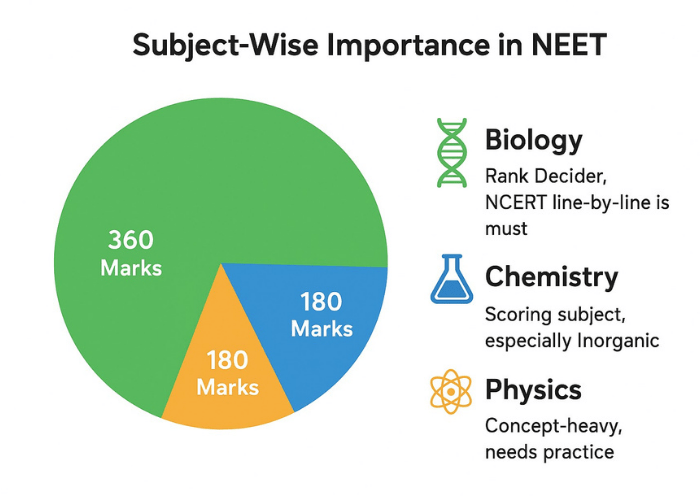
🧬 1. Biology (Most Important – 50% Weightage)
- Marks: 360 / 720 (90 questions)
- Why it matters: Determines rank; 80–90% of questions directly from NCERT.
- Key Topics: Human & Plant Physiology, Genetics, Ecology, Reproduction, Biotechnology
- Strategy:
- Study NCERT line by line
- Focus on diagrams & flowcharts
- Practice previous year questions
⚗️ 2. Chemistry (Moderate – 25% Weightage)
- Marks: 180 / 720 (45 questions)
- Why it matters: Easier to score than Physics.
- Key Topics:
- Physical: Mole Concept, Thermodynamics, Equilibrium
- Inorganic: Periodic Table, Chemical Bonding, Coordination Compounds
- Organic: GOC, Hydrocarbons, Biomolecules
- Strategy: Revise NCERT Inorganic thoroughly; practice Physical Chemistry numericals from reference books.
⚡ 3. Physics (Challenging – 25% Weightage)
Analyze mock test results regularly
Marks: 180 / 720 (45 questions)
Why it matters: The toughest but most rewarding subject for concept clarity.
Key Topics: Mechanics, Thermodynamics, Electrostatics, Current Electricity, Optics, Modern Physics
Strategy:
Master formulas and derivations
Solve at least 100+ MCQs daily
Analyze mock test results regularly
🧾 When NCERT Alone Isn’t Enough
| Aspect | NCERT Books | Reference Books |
| Purpose | Builds conceptual foundation | Deepens understanding & enhances practice |
| Coverage | 80–90% of Biology; some Chemistry & Physics basics | Numericals & higher-order concepts |
| Language | Simple & concise | Detailed & exam-oriented |
| Strengths | Ideal for quick revision & core clarity | Helps tackle complex questions |
| Limitations | Limited question practice | Time-consuming if used excessively |
| Best Use | Memorize, revise, and reinforce basics | Apply concepts through MCQs and problem-solving |
| Recommended Subjects | Biology, Inorganic Chemistry | Physics, Physical Chemistry, and advanced Biology |
Recommended Reference Books Alongside NCERT
Physics:
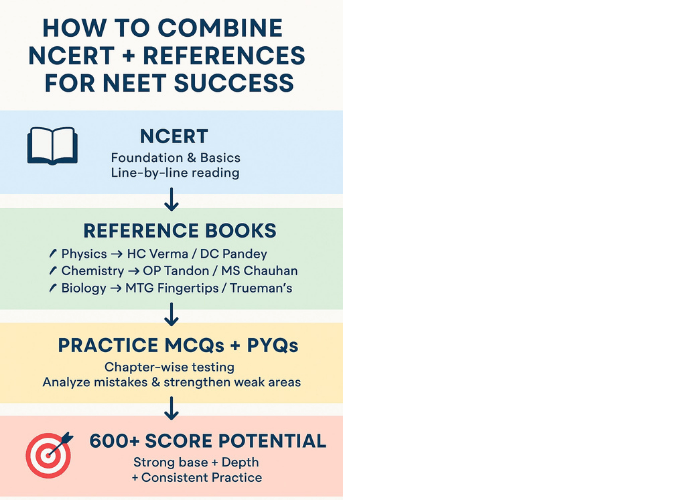
- Concepts of Physics – H.C. Verma
- Objective Physics – D.C. Pandey
Chemistry:
- Physical Chemistry – O.P. Tandon
- Organic Chemistry – M.S. Chauhan
Biology:
- MTG NCERT Fingertips
- Trueman’s Biology
These books complement NCERT by enhancing analytical thinking and providing ample practice questions.
🎯 How to Balance NCERT and Reference Books
- Start with NCERT: Understand every line, diagram, and table.
- Then switch to references: Practice higher-order and numerical problems.
- Use NCERT for revision: Go back before every mock test.
- Attempt mock tests weekly: Analyze errors and bridge gaps.
- Follow the 70-30 rule: 70% focus on NCERT, 30% on reference materials.
🏁 Conclusion
NCERT books are the heart of NEET preparation, offering conceptual clarity and reliability. However, reference books are the muscles that strengthen your analytical ability and problem-solving speed.
By combining NCERT for theory and reference books for practice, you create a complete preparation strategy.
With consistent revision, daily MCQs, and mock test analysis, scoring 600+ in NEET becomes achievable.
✨ Remember: “NCERT gives you knowledge. Practice gives you success.”
❓ FAQs for NEET Preparation
- Is NCERT enough for NEET?
NCERT is crucial for Biology and basic Chemistry, but Physics and advanced Chemistry need references for practice. - How many hours should a NEET aspirant study daily?
Ideally 8–10 focused hours, with regular breaks and daily revision. - Which subject is most important for NEET?
Biology holds 50% weightage and often decides rank. - How many mock tests should I take before NEET?
25–30 full-length mocks are ideal to build exam stamina. - How do I balance NCERT and references?
Study NCERT first for clarity, then use reference books for application and practice. - Can I crack NEET in one year?
Yes. With a structured NCERT-based approach, consistent practice, and mock tests, one year is enough.